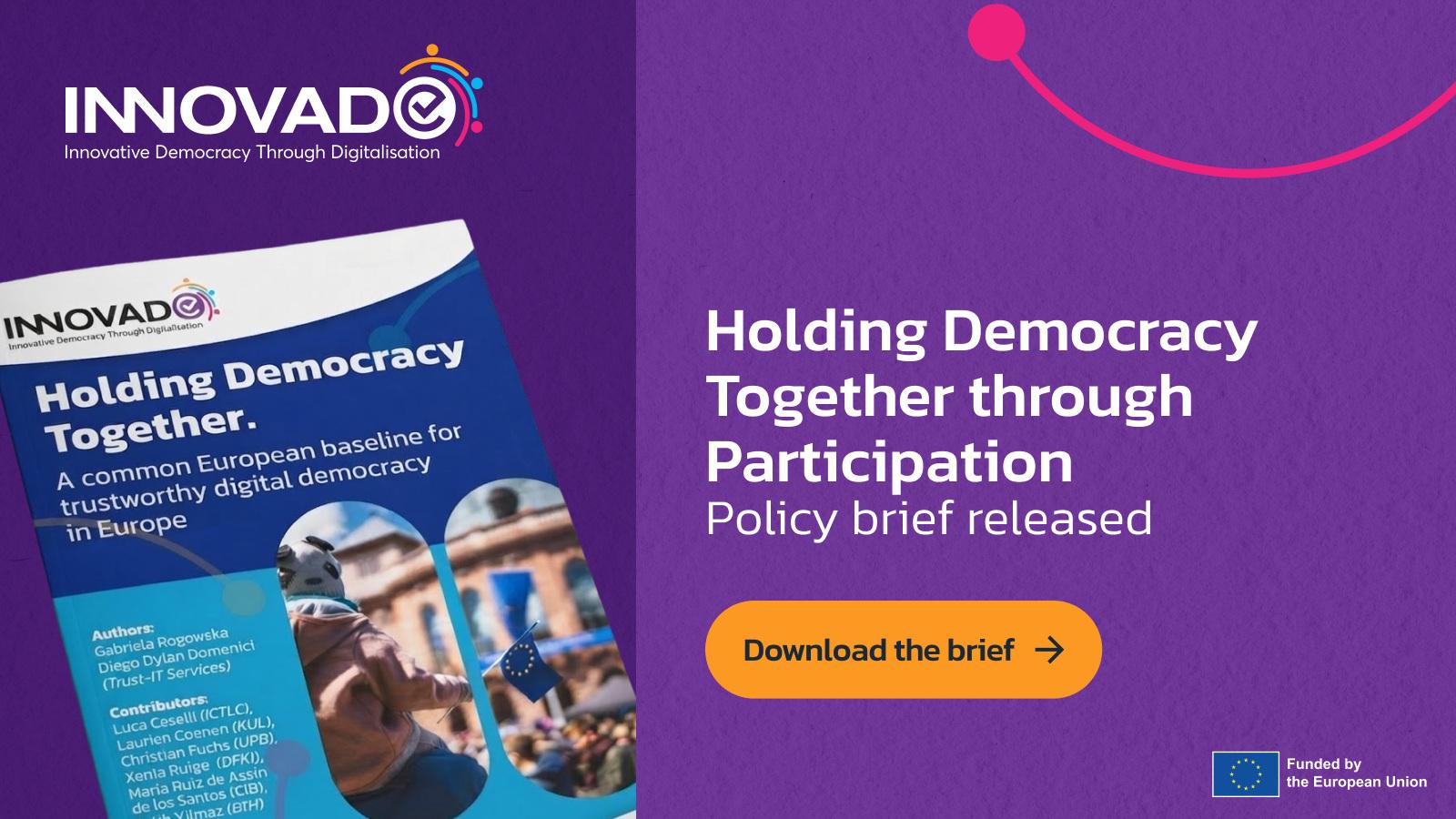
Following the United Nations' International Day for Democracy on 15 September, and this week's State of the Union, the INNOVADE consortium is spotlighting the findings of its policy brief, which argues that what makes digital democracy work is not new tools, but discipline: a floor of trustworthiness every initiative must clear before it launches, held consistently across Europe, and an impact that is tracked and reported, not assumed.
The brief, Holding Democracy Together: A Common European Baseline for Trustworthy Digital Democracy in Europe, distils eighteen months of research conducted under the EU-funded INNOVADE project: a citizen survey of more than 400 respondents, a questionnaire of 67 European public officials, a mapping of 141 platforms, an international expert survey of 331 specialists, and twenty expert interviews across five Member States, all tested through Living Labs bringing together policymakers, citizens, civil society, industry, and researchers.
A public that believes in democracy but doubts it delivers
The research lands on a stark public mood. Special Eurobarometer 568 found that 49% of Europeans name growing distrust of democratic institutions as the single most serious challenge facing EU democracy, ahead of disinformation (42%) and opaque AI-driven political content (32%); 85% want platforms to disclose the source of political messaging and guarantee parties equal access, yet only 18% regularly verify what they read online, and 91% have not taken part in any EU-level participatory process in the past five years. The Joint Research Centre's 2026 study on citizen engagement adds a counterpoint: 97% of administrations that ran engagement processes would run them again, but legitimacy collapses precisely where follow-up fails and citizens cannot see what became of their input. In other words, demand for participation is proven, what is missing is the infrastructure of trust.
Ten Ropes to Hold Democracy Together
INNOVADE's brief responds with ten recommendations for a common European baseline, organised into three tiers: support pillars that any initiative must meet before launch, state-of-the-art design principles for how tools are built regardless of provider, and foundation conditions that no single tool can deliver alone. Rather than inventing new mechanisms from scratch, several recommendations borrow deliberately from solutions that already work in other domains of citizens' digital lives.
The clearest example is the recommendation on impact accountability, which addresses the "black box effect": citizens submit an idea or a vote that simply disappears. Living Lab participants described wanting a parcel-tracking model of participation instead — the same logic that lets a shopper follow a package from dispatch to delivery, applied to a citizen's contribution, with a clear response even when nothing changed, and why. The brief proposes making this obligatory: a published Impact and Feedback Protocol for every publicly funded initiative, and a "Participation Debt" metric tracked as a standard reporting indicator.
It is one recommendation among ten, but it illustrates the brief's broader method: treat trust not as a mood to be cultivated, but as an operational failure to be fixed, often by borrowing infrastructure logic that already earns trust elsewhere.
Timed to a moment of real institutional momentum
The brief is offered as a contribution to the European Democracy Shield and the European Centre for Democratic Resilience, operational since February 2026.
"Europe cannot keep treating rights, technology, markets, and democratic participation as separate policy discourse. They are one conversation: what changes when citizens go online to have a say, what happens to their input afterwards, who they trust to run the platform, and whether the tools available to them are built by companies accountable to European law or not. This brief is our attempt to join those dots before the next wave of digital democracy tools gets built without them,"
said Fatih Yilmas from Beyond the Horizon, the Coordinator of the INNOVADE project.
Policy workshop
INNOVADE will convene a closed policy workshop on 6 October 2026, bringing together policymakers at local, national, and EU level, alongside partners from policy-oriented institutions, to stress-test the brief's recommendations against real institutional constraints ahead of a second, more actionable iteration.
The full brief is available open access via Zenodo (DOI: 10.5281/zenodo.21026681) and at innovade-democracy.eu/publications.